Bedding Guide
Choosing a Latex Topper: Thickness, Feel, and Fit
A latex topper can reshape the feel of a bed without replacing the mattress beneath it. The right choice depends on more than a label: thickness, firmness, latex type, mattress condition, and the way the layers fit together all influence what happens when you settle in for the night.
Think of a bed as a small landscape of materials. The mattress forms its terrain; a topper changes the contours at the surface. A thin layer may soften the first impression, while a thicker one can make a more noticeable difference to cushioning and pressure relief. But no topper can reliably correct a deeply sagging or damaged mattress. Choosing well begins with observing the bed you have—and identifying what you want to change.
First, be clear about what a topper does
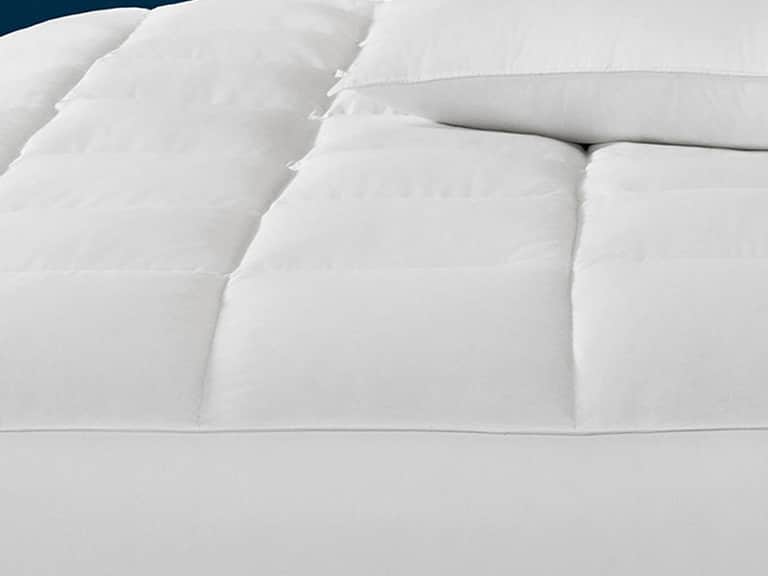
A latex mattress topper is a separate comfort layer placed on top of a mattress, usually beneath the fitted sheet. It may add softness, resilience, or a little extra cushioning. Unlike a mattress pad, which is often a relatively thin quilted layer, a topper is generally designed to alter the surface feel more substantially. And unlike a protector, a topper is not primarily a barrier against spills, perspiration, or other liquids.
Those categories can overlap in everyday conversation, and product names are not always used consistently. The details matter more than the title: look for the layer’s materials, thickness, construction, care instructions, and stated purpose. If spill protection is your priority, use a suitable mattress protector. A latex comfort layer should not be assumed to be waterproof or stain-resistant simply because it sits above the mattress.
Latex itself is valued for its springy response. Rather than slowly molding around the body in the way some people associate with memory foam, it tends to compress under pressure and recover its shape relatively quickly. The sensation varies by formulation, firmness, thickness, and the layers underneath. “Latex feel” is not one fixed experience.
Thickness: how much change do you want?
Topper thickness affects how much material sits between your body and the mattress. A thinner latex topper usually produces a more restrained change: it can take the edge off a firm surface while allowing more of the mattress’s original character to come through. A thicker layer creates more room for compression and may feel more distinct, though the result still depends on firmness and body weight.
There is no universally correct thickness. A useful starting point is to describe the problem rather than shop by a number. Is the mattress generally supportive but a little too firm at the shoulders or hips? Are you seeking a noticeably plusher surface? Or are you trying to compensate for a dip that has developed over time? These are different problems, and a topper is not equally suited to all of them.
- For a modest softening: consider a thinner layer if you want to preserve much of the mattress’s existing feel.
- For a more noticeable cushion: a thicker layer may change the surface more, but will also add height and may affect sheet fit.
- For a mattress with a persistent sag: assess the mattress and its foundation first. A topper may follow the shape of an uneven surface rather than restore it.
These are broad tendencies, not guarantees. A firm, thin topper can feel different from a soft, thin one; a person’s build and preferred sleeping position also influence how deeply the material compresses. When available, consult the manufacturer’s specifications and return or exchange terms. A measurement alone cannot predict comfort, but it can help narrow the field.
Remember that added thickness raises the height of the sleep surface. That can matter for getting in and out of bed, for the appearance of the mattress and bed frame, and for whether fitted sheets still stay in place. Check the combined height of mattress and topper, not only the topper’s advertised depth.
Firmness: a response, not a universal scale
Firmness descriptions—soft, medium, or firm—are useful shorthand, but they are not perfectly standardized across manufacturers. One company’s “medium” may not feel identical to another’s. The impression also changes with the mattress beneath: the same topper may feel more yielding over a softer base and more buoyant over a firm one.
For many sleepers, the aim is not simply to choose the softest surface. It is to balance cushioning with support. A surface that feels inviting at first can still be uncomfortable if the body settles in a way that does not suit the sleeper. Conversely, a firm surface may feel supportive but create uncomfortable pressure at contact points. Comfort is individual and can be affected by body shape, sleeping posture, temperature preferences, and the condition of the mattress.
Consider your usual position as one clue, not as a prescription. Side sleepers often pay close attention to cushioning around the shoulders and hips. Back sleepers may prefer a surface that adds some comfort without substantially changing the support they already value. Stomach sleepers commonly want to avoid a surface that feels excessively yielding. These are general observations; personal comfort varies, and persistent pain or sleep problems deserve discussion with a qualified health professional rather than reliance on bedding changes alone.
If two people share a bed, their preferences may differ. A single topper changes the surface across the full mattress, which can make compromise more important. Some systems offer separate or configurable layers, but verify their dimensions, compatibility, and intended use before making assumptions. A split arrangement may suit one bed design and not another.
Latex type and construction
Latex is made in different ways, and construction can influence feel, consistency, and the way a layer is described. Dunlop and Talalay are two common latex processes. They are not firmness ratings: each process can produce materials at different firmness levels, and the final sensation depends on the specific formulation and the rest of the bed.
Product information may also distinguish natural, synthetic, or blended latex. Read the material description closely instead of inferring composition from a broad word such as “latex” or “natural.” If a specific ingredient or certification is important to you, check the exact scope of the claim and the documentation supplied by the manufacturer. Certifications address defined criteria; they do not automatically tell you how a topper will feel or whether it is the right choice for your needs.
Some latex layers include a cover, while others are sold as components for use within a compatible mattress system. A cover can affect handling and care, so find out whether it is removable and what cleaning methods are permitted. Latex products should not be soaked, machine-washed, or treated with household cleaners unless the care label explicitly allows it. Follow the maker’s instructions: the safest routine may be spot cleaning or airing rather than laundering.
Construction also affects how the layer stays in place. A topper may rely on its weight, a fitted cover, corner straps, or the sheet to hold position. The right arrangement depends on the mattress surface, the topper design, and how closely the bedding fits. If the layer shifts, bunches, or curls at an edge, the issue may be a mismatch in size, attachment method, or overall bed setup.
Measure for a secure fit
Before comparing firmness, confirm the footprint. Measure the mattress length and width, then compare those figures with the topper’s stated dimensions. Standard size names can be helpful, but actual dimensions and naming conventions may vary. Pay particular attention to less common sizes and to mattresses that have been custom-made.
Next, measure mattress depth. A topper adds to that depth, and the fitted sheet must accommodate the combined height. A sheet that barely fits the mattress on its own may pull loose once a topper is added. Deep-pocket sheets can help, but pocket depth should be checked against the total height of the mattress, topper, and any other layers—not guessed from the bed size alone.
- Measure the mattress rather than relying only on its size label.
- Check whether the topper dimensions match the mattress’s length and width.
- Add the topper’s thickness when checking fitted-sheet pocket depth.
- Confirm whether the bed frame, headboard, or guard rail will remain practical with the extra height.
- For adjustable bases, verify that the topper is compatible with the movement and design of the base.
A topper should lie flat and cover the intended sleep surface. A small mismatch can cause exposed edges, overhang, or movement during the night. For a split mattress or adjustable arrangement, ask whether a single full-width layer is appropriate or whether separate pieces are needed. Do not assume that a topper designed for a conventional flat bed will behave identically on every base.
A topper cannot repair every mattress
It is tempting to treat a topper as a quick fix for any uncomfortable bed. It can be a practical way to adjust the feel of a sound mattress, but it does not rebuild the mattress’s internal support. If the bed has a pronounced hollow, broken components, or a foundation that is no longer stable, adding a new layer may simply reproduce the uneven shape above it.
Inspect the mattress and its base before deciding. Look for visible dips, broken slats, a shifted foundation, or signs that the mattress is not sitting evenly. Check the mattress maker’s care and warranty guidance as well. A topper may affect warranty terms or the way a specific mattress system is meant to be used; consult the applicable documentation rather than relying on assumptions.
Age alone is not a complete test. Some mattresses remain comfortable for a long time; others lose their feel sooner because of materials, use, or support conditions. What matters in this decision is whether the underlying surface still performs acceptably for you. If the mattress itself has become uneven or unsupportive, a surface layer is unlikely to solve the underlying cause.
Fit, care, and everyday use
Latex toppers can be bulky and awkward to maneuver, particularly in larger sizes. Plan how you will place and remove the layer, and follow the manufacturer’s handling instructions. Avoid folding or compressing it in ways the maker does not recommend. If it arrives rolled or compressed, allow it to recover according to the supplied directions before judging its final shape.
Care instructions vary. Check whether the cover can be removed, whether it can be washed, and how the latex core should be protected from moisture or direct heat. A protector above the topper can help shield the sleep surface from everyday spills and perspiration, but its material and construction may change the feel or airflow. Select one that fits the combined bed height and is appropriate for the protection you need.
Give yourself time to assess a new setup. Notice whether pressure, ease of movement, and the general surface feel improve or worsen over several nights. Keep in mind that bedding changes can alter how a familiar mattress feels, and first impressions are not always the whole story. If a seller offers a trial period, read the conditions carefully: return windows, packaging rules, pickup arrangements, and fees can vary.
A note on latex in layered beds
Latex can appear as a separate topper or as part of a mattress built from several layers. Those arrangements are related, but they are not interchangeable. With a separate topper, you place an additional layer over an existing mattress. In a layered mattress, the topper-like component may be designed to work with the other layers, cover, and foundation as a complete system.
For example, the Savvy Rest Unity Pillowtop Latex Mattress is described as a layered latex mattress with a separate soft top layer in its own organic casing. Its configuration illustrates how a topper-like layer can be integrated into a broader mattress design; it is not, by itself, a standalone latex topper for any mattress. That distinction matters when checking dimensions, compatibility, and what can be changed or moved.
When comparing complete systems with add-on toppers, ask what the product is intended to sit on, whether its layers are replaceable, and whether the maker specifies a compatible foundation. A component that performs well as part of a tested arrangement may not produce the same result when used independently.
A practical comparison checklist
Before deciding, write down what the current mattress does well and what you hope to change. That small inventory can help separate a genuine need from an appealing specification. Then compare options using the same questions:
- Purpose: Am I seeking a softer surface, added cushioning, or a different response?
- Mattress condition: Is the mattress even and supportive, or is there a sag or structural problem?
- Thickness: How much should the topper alter the original feel, and how much height can the bed accommodate?
- Firmness: What firmness options are available, and how does the manufacturer describe them?
- Material: Is the latex natural, synthetic, or blended, and are the relevant claims clearly documented?
- Dimensions: Does the topper match the mattress, including any nonstandard size?
- Sheet fit: Will existing sheets accommodate the combined depth?
- Care: Can the cover be removed, and what cleaning methods are allowed?
- Compatibility: Is the layer suitable for the mattress, foundation, or adjustable base in use?
- Trial and return terms: What conditions apply if the feel or fit is not right?
For an objective comparison, avoid focusing on one specification in isolation. A thicker layer is not automatically more comfortable; a natural-material claim is not a firmness guide; and a generous return period does not prove that a design will suit every sleeper. The best match is the option whose documented features align with your actual bed and your stated priorities.
The decision in brief
Choosing a latex topper is an exercise in proportion. Thickness determines how much material can cushion the body and how substantially the bed’s surface may change. Firmness influences the initial resistance and the depth of compression. Fit determines whether the layer stays neatly in place, while construction and care instructions shape what it takes to live with over time.
Begin with the mattress, not the product page. Identify whether the surface is too firm, too soft, uneven, or simply in need of protection. Measure the bed and account for added height. Then compare latex type, firmness descriptions, cover details, compatibility, and trial terms. A topper can be a useful comfort layer when the mattress beneath it is still in good condition. It is not a substitute for a protector, a repair, or a new mattress when the underlying support has failed.
In a well-matched bed, the extra layer does not need to announce itself. It simply changes the first few inches of the sleep surface in a way that feels more appropriate—an adjustment of the terrain rather than a reconstruction of the landscape beneath.